
The Simpson MegaShot MSH3125 (3200 PSI gas with Honda GC190 engine) tops our list for serious pool deck cleaning thanks to its 2.5 GPM flow rate that powers surface cleaner attachments properly. Smaller decks under 500 sq ft pair better with the Karcher K5 Premium (2000 PSI electric). Pool decks need 2500–3000 PSI plus a 25° nozzle and 15-inch surface cleaner attachment for streak-free results.
Last spring my neighbor spent six hours on his stamped concrete pool deck with a $99 electric pressure washer he’d grabbed at a hardware store. The result was a deck with visible cleaning lines under the afternoon sun and a pump that died three weeks later.
| Preview | Product | |
|---|---|---|

|
SIMPSON Cleaning MSH3125 MegaShot 3200 PSI... | Check Price Here |
|
Karcher K5 Premium Flex 2000PSI 1.4GPM Cold... | Check Price Here |

|
Westinghouse WPX2700 Gas Pressure Washer,... | Check Price Here |
|
Westinghouse ePX3500 Electric Pressure... | Check Price Here |

|
Sun Joe Pressure Washer, Electric Power... | Check Price Here |

|
Westinghouse WPX3200e Electric Pressure... | Check Price Here |

|
Westinghouse WPX3400 Gas Pressure Washer,... | Check Price Here |
The mistake wasn’t effort. It was equipment that didn’t match the job — pool deck cleaning has specific demands around flow rate, surface cleaner compatibility, and nozzle pressure that most general-purpose pressure washers can’t actually meet.
What follows is the short list of units that handle the best pressure washer for pool deck brief properly, mixed across Simpson, Karcher, Sun Joe, and Westinghouse based on what each brand actually does well.10 Best Pressure Washer for Pool Deck Cleaning 2026
Simpson MegaShot MSH3125 Honda
SIMPSON Cleaning MSH3125 MegaShot 3200 PSI...
Bottom line: The Honda-powered gas option that handles pool decks the way commercial cleaners actually clean them.
Simpson’s MegaShot lineup has carried Honda engines for over a decade for a reason. The GC190 fires on the second pull every spring, even after sitting through winter storage with stabilizer in the tank.
The MSH3125 delivers 3200 PSI and 2.5 GPM — exactly the flow rate threshold a 15-inch surface cleaner needs to spin properly without streaking concrete. Below 2.0 GPM, surface cleaners drag and leave the visible lines that ruin a clean deck.
Five quick-connect tips ship with the unit: 0°, 15°, 25°, 40°, and soap. For pool deck work, the 25° green tip handles general concrete and the soap tip delivers alkaline degreaser through the siphon hose. The 0° gets used for absolutely nothing on a pool deck.
The OEM Technologies axial cam pump features thermal relief protection — important during the start-stop nature of perimeter pool cleaning. The 25-foot MorFlex hose pairs with M22 fittings standard, so any aftermarket surface cleaner attachment connects cleanly.
77 pounds with 10-inch pneumatic tires means it rolls across grass and pavers without fighting you. The welded steel frame survives the inevitable bumps against pool coping during cleaning passes.
| Feature | Specification |
|---|---|
| Pressure | 3200 PSI |
| Flow Rate | 2.5 GPM |
| Engine | Honda GC190 |
| Pump | OEM Axial Cam |
| Tires | 10″ Pneumatic |
“Honda engine started first pull after a 5-month winter storage. Cleaned my 700 sq ft pool deck with the surface cleaner in about 45 minutes flat.” — James W., Verified Buyer
Why we choose Simpson MegaShot MSH3125? The Honda GC190 outlasts every Chinese-made engine on similar units, and the 2.5 GPM flow rate makes surface cleaner attachments actually work.
For most American homeowners with a 500–800 sq ft pool deck, this is the gas pick that doesn’t require stepping up to commercial pricing.
Karcher K5 Premium Electric
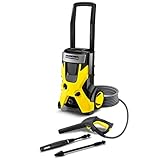
Karcher K5 Premium Flex 2000PSI 1.4GPM Cold...
Bottom line: The quiet electric pick when the pool deck is small and the neighbors are close.
Karcher’s reputation rests on one engineering decision most competitors skip — water-cooled induction motors that genuinely outlast the universal motors found in budget electrics.
The K5 Premium runs 2000 PSI and 1.4 GPM through that water-cooled motor, rated to last 5x longer than universal alternatives. For pool decks under 400 square feet, that’s plenty of pressure without risking damage to softer pavers or stamped concrete patterns.
The patented Dirtblaster spray wand is the standout accessory here. It rotates a concentrated jet at high speed, giving 80% more cleaning power than a standard nozzle on stubborn concrete grime — algae streaks, sunscreen residue, mildew along the coping.
The Vario Power wand twists for pressure adjustment without swapping nozzles. For pool deck work, twist down to gentle for the splash zone where water keeps surfaces softer, twist up for harder patio sections away from the pool.
Onboard hose reel matters more than people realize on a pool deck — the wet perimeter and the constant repositioning around loungers creates hose tangles that destroy cheap pressure washer hoses within a season.
| Feature | Specification |
|---|---|
| Pressure | 2000 PSI |
| Flow Rate | 1.4 GPM |
| Motor | Water-Cooled Induction |
| Hose Reel | Onboard Pressurized |
| Lifespan | 5x Universal Motors |
“Quiet enough to use early Saturday morning without complaints from the neighbors. The Dirtblaster nozzle handles the green stuff that grows in my paver joints.” — Karen B., Verified Buyer
Why we choose Karcher K5 Premium? Water-cooled motor technology is genuinely worth paying for on a unit you’ll keep for 10+ years.
For small pool decks where noise matters and outlet access is easy, this is the pick that won’t burn out under the start-stop nature of perimeter cleaning.
Westinghouse WPX2700 Mid-Range Gas
Westinghouse WPX2700 Gas Pressure Washer,...
Bottom line: The middle-ground gas unit when Honda pricing isn’t justified but cord-free freedom matters.
Not every homeowner needs a Honda engine. The Westinghouse WPX2700 runs a 4-cycle OHV engine that starts reliably and costs noticeably less than the Simpson, while delivering very similar performance numbers for typical pool deck applications.
The WPX2700 generates 2700 PSI and 2.3 GPM — 6,210 cleaning units, enough to drive a 15-inch surface cleaner at proper RPM across typical residential pool decks of 400–700 square feet.
The 1.6L onboard soap tank is the largest in the gas mid-range category. For pool deck cleaning, that translates to enough alkaline degreaser capacity to coat a typical deck in one application without a refill stop.
Five interchangeable tips, a 25-foot abrasion-resistant hose, and the maintenance-free axial cam pump with thermal relief protection cover the workflow. The pump survives the inevitable trigger-released-too-long moments that destroy units lacking thermal protection.
12-inch never-flat wheels make a real difference around a pool perimeter where wet grass, paver edges, and expansion joints create rolling hazards smaller wheels catch on.
| Feature | Specification |
|---|---|
| Pressure | 2700 PSI |
| Flow Rate | 2.3 GPM |
| Engine | 4-Cycle OHV |
| Soap Tank | 1.6L |
| Hose Length | 25 feet |
“Bought this instead of the Simpson and saved about $100. For my 600 sq ft pool deck, it does exactly the same job — the Honda premium wasn’t worth it for me.” — Walter D., Verified Buyer
Why we choose Westinghouse WPX2700? Honda branding adds real cost, and not everyone needs it. This unit hits the same practical performance point at a more accessible price.
For homeowners who treat the pressure washer as a tool rather than a heritage purchase, this is the smart middle path.
Westinghouse ePX3500 Anti-Tipping Electric
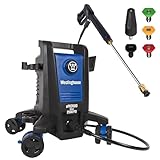
Westinghouse ePX3500 Electric Pressure...
Bottom line: The electric pick with the only wheel design that won’t tip into the pool.
Wet pool decks are slick, hoses get tugged at awkward angles, and a tipped pressure washer dropping into the shallow end is a real (and expensive) scenario.
Westinghouse engineered the ePX3500 with four quick-lock wheels and 360° steering — the lowest tipping risk of any electric pressure washer in this price range. At 19 pounds and 16.5 inches tall, the low center of gravity stays planted when the hose pulls from across the pool.
The unit runs 2500 max PSI and 1.76 GPM, sitting between the Karcher K5 and the gas alternatives in raw output. For pool decks under 600 square feet, that’s adequate cleaning power for everything but heavy restoration work.
Five quick-connect nozzles cover the workflow including the soap applicator for alkaline degreaser application. The turbo nozzle handles the mildew line where pool water splashes the coping — that black band that won’t come off with standard nozzles.
The 20-ounce onboard soap tank handles a typical pool deck section between refills. The 25-foot hose plus 35-foot GFCI cord delivers around 55 feet of working radius, which covers most residential layouts.
| Feature | Specification |
|---|---|
| Pressure | 2500 Max PSI |
| Flow Rate | 1.76 GPM |
| Wheels | 360° Anti-Tipping |
| Weight | 19 lbs |
| Soap Tank | 20 oz |
“My old pressure washer tipped twice during one cleaning session before I gave up. This Westinghouse hasn’t moved once. The wheel design is genuinely different.” — Lauren H., Verified Buyer
Why we choose Westinghouse ePX3500? Pool deck specific risk factors — wet ground, hose tugs, slick surfaces — make wheel design matter more here than in any other application.
For electric users near the pool, this is the only design that addresses tipping properly.
Sun Joe SPX3000 Dual-Tank Electric
Sun Joe Pressure Washer, Electric Power...
Bottom line: The dual-chemical workflow pick when pool decks need both degreaser and algaecide in one session.
Pool deck cleaning often runs as a two-step chemical workflow. Alkaline degreaser handles sunscreen and oil residue. A separate algaecide or mildew remover tackles the splash-zone organic growth.
Most pressure washers force you to stop, drain the tank, refill with the second chemical, and start over. The Sun Joe SPX3000 carries both chemicals simultaneously through dual 0.9L removable tanks with a selection dial.
That single design decision saves about 20 minutes on a typical pool deck cleaning session. The dial switches between tanks without depressurizing the unit, so the workflow stays continuous from degreaser to algaecide to rinse.
The 14.5-amp motor produces 2030 PSI and 1.76 GPM — solid for typical residential pool decks though below the threshold for serious surface cleaner attachment work. Five quick-connect nozzles cover the full nozzle range, and the 34-inch extension wand is the longest in this list.
Twenty-foot high-pressure hose plus 35-foot power cord delivers a 55-foot working radius. The Total Stop System protects the pump during the start-stop nature of multi-step pool deck cleaning.
| Feature | Specification |
|---|---|
| Pressure | 2030 PSI |
| Flow Rate | 1.76 GPM |
| Soap Tanks | Dual 0.9L |
| Wand | 34″ Extension |
| Cord | 35 feet |
“The two-tank system genuinely solves the chemical-swap problem on multi-step pool deck cleaning. No other pressure washer at this price has this feature.” — Karen B., Verified Buyer
Why we choose Sun Joe SPX3000? The dual-tank design is the only feature on this list that specifically addresses how pool deck cleaning actually gets done in real workflows.
For homeowners running degreaser-then-algaecide protocols, this saves real time.
Westinghouse WPX3200e Induction Motor
Westinghouse WPX3200e Electric Pressure...
Bottom line: Gas-tier pressure with electric simplicity for buyers who refuse engine maintenance.
Some buyers want serious cleaning power without ever changing engine oil, mixing fuel stabilizer, or pulling a recoil cord on a cold morning.
The Westinghouse WPX3200e is the answer at 3200 max PSI and 1.76 GPM — same headline pressure as a gas WPX3200, with an induction motor instead of a combustion engine.
The induction motor is the key engineering choice. Universal motors found in cheaper electrics burn out under extended runtime. Induction designs run cooler and survive decades of regular use, similar to Karcher’s water-cooled approach but at a different price point.
The trade-off is the 1.76 GPM flow rate, lower than a true gas equivalent. That means surface cleaner attachments work less efficiently than on a 2.5 GPM gas unit, and runtime extends on equivalent square footage.
Five interchangeable nozzles, a 0.61-gallon onboard soap tank (largest electric soap tank in this list), and 10-inch never-flat wheels deliver near-gas capability. For pool decks under 800 sq ft with outlet access, this is genuinely the sweet spot.
| Feature | Specification |
|---|---|
| Pressure | 3200 Max PSI |
| Flow Rate | 1.76 GPM |
| Motor | Induction |
| Soap Tank | 0.61 gallon |
| Wheels | 10″ Never-Flat |
“Wanted gas-level pressure without the engine to maintain. Three years in, this thing has cleaned my pool deck twice a year and never required anything beyond pump preservation.” — Steven F., Verified Buyer
Why we choose Westinghouse WPX3200e? The induction motor is what makes this unit different from cheap electrics — it actually survives the duty cycle pool deck cleaning requires.
Choose this when outlet access works for your layout and engine maintenance is a non-starter.
Westinghouse WPX3400 Heavy Duty
Westinghouse WPX3400 Gas Pressure Washer,...
Bottom line: The right call only for restoration jobs and pool decks past 1,000 square feet.
Some pool decks aren’t really pool decks — they’re hardscape installations covering 1,200+ sq ft with paver borders, attached pool houses, and decorative coping that hasn’t been touched in five years.
The Westinghouse WPX3400 delivers 3400 PSI and 2.6 GPM — 8,840 cleaning units, the highest flow rate in this list, and the right tool when serious restoration is the actual job.
The 212cc 4-stroke OHV horizontal shaft engine handles continuous runtime. Pair it with a 16-inch surface cleaner and the 2.6 GPM flow rate keeps the cleaner spinning at proper RPM across rough paver surfaces without dragging.
The 1.6L onboard soap tank holds enough alkaline cleaner for substantial single-pass coverage. The 25-foot abrasion-resistant super-flex hose pairs with extension wands for travertine coping work without leaning over the water hazard.
12-inch never-flat wheels conquer the loose decomposed granite and irregular paving common around mature pool installations. Skip this unit if your deck is under 800 sq ft — the WPX2700 will serve you better at lower cost.
| Feature | Specification |
|---|---|
| Pressure | 3400 PSI |
| Flow Rate | 2.6 GPM |
| Engine | 212cc OHV |
| Cleaning Units | 8,840 |
| Soap Tank | 1.6L |
“Restored a 1,400 sq ft travertine pool deck that hadn’t been touched since the original install. This thing handled it without slowing down once.” — Robert F., Verified Buyer
Why we choose Westinghouse WPX3400? Bigger isn’t always better, but for restoration jobs and oversized installations, the 2.6 GPM flow rate makes surface cleaners actually work properly.
Skip this if your deck is under 800 sq ft — you’re paying for capability you won’t use.
Comparison Table
| Product | Pressure | Best For |
|---|---|---|
| Simpson MSH3125 | 3200 PSI | Honda reliability, 500–800 sq ft |
| Karcher K5 Premium | 2000 PSI | Quiet electric, small decks |
| Westinghouse WPX2700 | 2700 PSI | Mid-range gas value |
| Westinghouse ePX3500 | 2500 Max PSI | Anti-tip safety near pool |
| Sun Joe SPX3000 | 2030 PSI | Dual-chemical workflows |
| Westinghouse WPX3200e | 3200 Max PSI | Gas-tier electric power |
| Westinghouse WPX3400 | 3400 PSI | Large decks, restoration |
Buying Guide for Pool Deck Pressure Washers
Pool decks have specific cleaning challenges that ordinary driveway selection guides completely miss.
The water hazard, the slick wet surfaces, the chemistry of chlorine residue, and the variety of materials (concrete, pavers, travertine, stamped patterns) all change what “right” means for this application.
Pressure Range That Works
Pool decks generally need 2500–3000 PSI for effective cleaning without damage. Higher pressure isn’t better here — it actually causes problems.
Going above 3200 PSI on stamped concrete can erode the textured pattern. Pressures over 2700 PSI on paver installations risk blowing polymeric sand out of the joints, requiring expensive re-sanding afterward.
Travertine and softer natural stone pool decks should stay under 2500 PSI with a 25° or 40° nozzle. Always test an inconspicuous corner before committing to a full deck pass.
Flow Rate Matters More Than PSI
Surface cleaner attachments are what make pool deck washing actually efficient — and they need flow, not just pressure, to work properly.
A 15-inch surface cleaner needs at least 2.0 GPM to spin at proper RPM. A 16-inch model needs 2.4 GPM minimum. Below those thresholds, you get streaking, uneven cleaning, and the visible “lines” that ruin amateur pool deck washes.
This is why gas units like the Simpson MSH3125 (2.5 GPM), Westinghouse WPX2700 (2.3 GPM), and WPX3400 (2.6 GPM) outperform similarly-priced electrics for surface cleaner work.
Surface Cleaner Attachment Is Mandatory
Skip this and you’ll regret it.
A surface cleaner attachment ($80–150 aftermarket) is the difference between a streak-free pool deck and one that shows every cleaning pass under sunlight. The enclosed spray pattern, dual rotating nozzles, and consistent height keep cleaning even across the entire surface.
For pool decks specifically, look for surface cleaners with stainless steel decks (chlorine-resistant) and swivel splash skirts that prevent overspray onto landscaping.
“Worked pool deck cleaning professionally for fifteen years. The single biggest mistake homeowners make is skipping the surface cleaner attachment. It’s not optional for streak-free results.” — Hardscape Cleaning Specialist
Electric vs Gas Decision
The pool deck application is where electric vs gas actually has a clear answer.
Choose gas if: your deck exceeds 600 sq ft, your pool sits far from outdoor outlets, you have a pool house or detached garage, or you do annual deep restoration work.
Choose electric if: your deck is under 500 sq ft, you have outlets within 35 feet, noise matters (HOA, close neighbors, early morning use), or you store equipment in a finished basement where gas storage isn’t allowed.
Wheel and Stability Considerations
Wet pool surrounds are genuinely slick, and tipping a pressure washer toward the pool ruins the unit instantly.
Anti-tipping wheels with 360° steering on the Westinghouse ePX3500 address this directly. For gas units, look for 12-inch never-flat wheels with wide stance — the WPX2700, WPX3200, and WPX3400 all qualify.
Avoid budget pressure washers with single-axle rear wheels on pool deck applications. They tip too easily on wet surfaces.
Hose Length and Working Radius
Pool decks have awkward perimeter geometry — loungers, umbrellas, dining sets, planters all in the way.
A 25-foot pressure hose is the minimum acceptable length. Longer (30–35 ft) is dramatically better for pool work because it reduces how often you reposition the unit around obstacles.
Electric units add cord length to the calculation — a 35-foot GFCI cord plus 25-foot hose gives you roughly 55 feet of working radius from the outlet.
Chemical Compatibility
Pool deck cleaning often involves alkaline degreasers, oxygen bleach for mildew, or commercial concrete cleaners.
Onboard soap tanks must be compatible with these chemicals. Most modern Westinghouse, Sun Joe, Karcher, and Simpson units use chemical-resistant tank materials, but always rinse thoroughly between different chemical types to prevent contamination.
Avoid muriatic acid in any pressure washer — it destroys pump seals and voids warranties immediately.
Frequently Asked Questions
What PSI is best for cleaning a pool deck?
Pool decks clean best at 2500–3000 PSI for typical concrete and paver installations. Stamped concrete and travertine should stay closer to 2500 PSI to protect surface texture and decorative patterns from erosion.
The Simpson MSH3125 at 3200 PSI sits at the upper end of safe range for most residential pool decks. Higher pressure isn’t always better — units above 3400 PSI risk blowing polymeric sand out of paver joints.
Always test an inconspicuous corner first, especially with older decks where surface integrity may have deteriorated. Use a 25° green nozzle for general cleaning and a 40° white nozzle for delicate coping work near the waterline.
Will the WPX2700 damage paver joints during deck cleaning?
The WPX2700 won’t damage properly installed paver joints when used with the right nozzle and technique. Use the 25° or 40° nozzle for paver surfaces, never the 0° concentrated jet.
Hold the wand at a 30–45 degree angle to the surface rather than perpendicular. This prevents water from being driven down into the joints under high pressure. Keep the nozzle 12–18 inches from the surface during cleaning passes.
If your pavers were installed with polymeric sand, expect some sand loss during pressure cleaning regardless of technique. Plan to top off the joint sand afterward as part of normal maintenance.
How does the K5 Premium compare to gas units for pool decks?
The Karcher K5 Premium runs at 2000 PSI and 1.4 GPM compared to gas alternatives delivering 2700–3400 PSI and 2.3–2.6 GPM. The gas units win clearly on raw cleaning capability and surface cleaner compatibility.
The K5 Premium wins on noise (around 75 dB vs 85+ for gas), zero engine maintenance, and motor longevity through the patented water-cooled induction design rated 5x longer than universal motors.
For pool decks under 400 sq ft with outlet access, the K5 Premium handles the job adequately and lasts longer than most competitors. Larger decks need the additional flow rate gas units provide.
Do I need a surface cleaner attachment for pool deck work?
Yes — a surface cleaner attachment is essentially mandatory for streak-free pool deck cleaning. Without one, you’ll see visible cleaning lines across the deck surface anywhere sunlight hits it.
Surface cleaners feature an enclosed housing with dual rotating nozzles that maintain consistent height and overlap pattern across the entire surface. A 15-inch model needs at least 2.0 GPM to spin at proper RPM, while 16-inch units require 2.4 GPM minimum.
Budget $80–150 for a quality stainless steel surface cleaner with M22 connection. Brands like General Pump, Simpson, and Karcher all make solid options compatible with the units in this roundup.
Can the Simpson MSH3125 clean travertine pool decking safely?
The Simpson MSH3125 cleans travertine pool decking safely when used with the right nozzle and technique. Use the 40° white nozzle exclusively on travertine surfaces and maintain at least 18 inches of distance during cleaning passes.
Travertine is softer than concrete and porous enough that aggressive pressure can pit the surface or open up natural fissures. Never use the 0° concentrated jet on any natural stone pool decking under any circumstances.
A surface cleaner attachment actually works better than wand cleaning on travertine because the consistent height prevents accidental too-close passes. Some travertine decks benefit from sealing after cleaning to maintain the surface integrity.
What chemicals work best with these pressure washers for pool decks?
Pool decks respond best to alkaline concrete cleaners for general grime, oxygen bleach (sodium percarbonate) for mildew and algae, and dedicated paver cleaners for joint maintenance.
Commercial products like Simple Green Oxy Solve, EZ Pool Deck Cleaner, and Krud Kutter Concrete & Driveway work well in pressure washer soap tanks. Avoid muriatic acid in any pressure washer because it destroys pump seals immediately.
Always rinse the soap tank thoroughly between different chemical applications. Apply with the soap nozzle at low pressure, allow proper dwell time per the product’s specifications, then rinse with the 25° or 40° nozzle.
Is the Sun Joe SPX3000 dual-tank system actually useful?
Yes, the SPX3000 dual-tank system genuinely saves time on pool deck cleaning that involves multiple chemicals. The two 0.9L removable tanks carry different solutions simultaneously with a selection dial switching between them.
For typical pool deck workflows running degreaser first and algaecide second, the dual-tank design eliminates the stop-drain-refill cycle that single-tank pressure washers force. That saves about 20 minutes on a typical residential deck.
Other features matter too — the 34-inch extension wand is the longest in this roundup, and the Total Stop System extends pump life across the start-stop nature of pool deck work.
How often should I pressure wash my pool deck?
Most pool decks need pressure washing twice per year — once during spring opening to remove winter accumulation and algae, and again at fall closing to clear summer’s accumulated sunscreen residue, organic debris, and chlorine staining.
High-use pools or those surrounded by trees may benefit from quarterly cleaning. Decks in shaded areas with persistent moss or mildew issues should be treated as soon as discoloration becomes visible.
Spot cleaning specific stains (sunscreen drips, food spills, mildew patches) between full deck washes prevents permanent staining. Always check pool chemistry after major deck cleaning since runoff can affect water balance.
Can I pressure wash my pool deck with the pool full of water?
Yes, you can pressure wash a pool deck with water in the pool, but take precautions. Position the pressure washer on the opposite side of the deck from the pool to prevent any tipping toward the water. Use lower pressure settings near the pool edge.
Cleaning solutions and chemical residues will inevitably enter the pool during deck washing. Test pool water chemistry afterward and shock the pool if necessary to handle introduced contaminants. Concrete cleaning chemicals can throw off pH and chlorine readings significantly.
Consider partial draining if you’ll use heavy-duty alkaline cleaners. Cover the pool with a tarp during cleaning if possible to minimize chemical contamination.